
Are You in Perimenopause? Signs to Watch For (That You Might Not Expect)
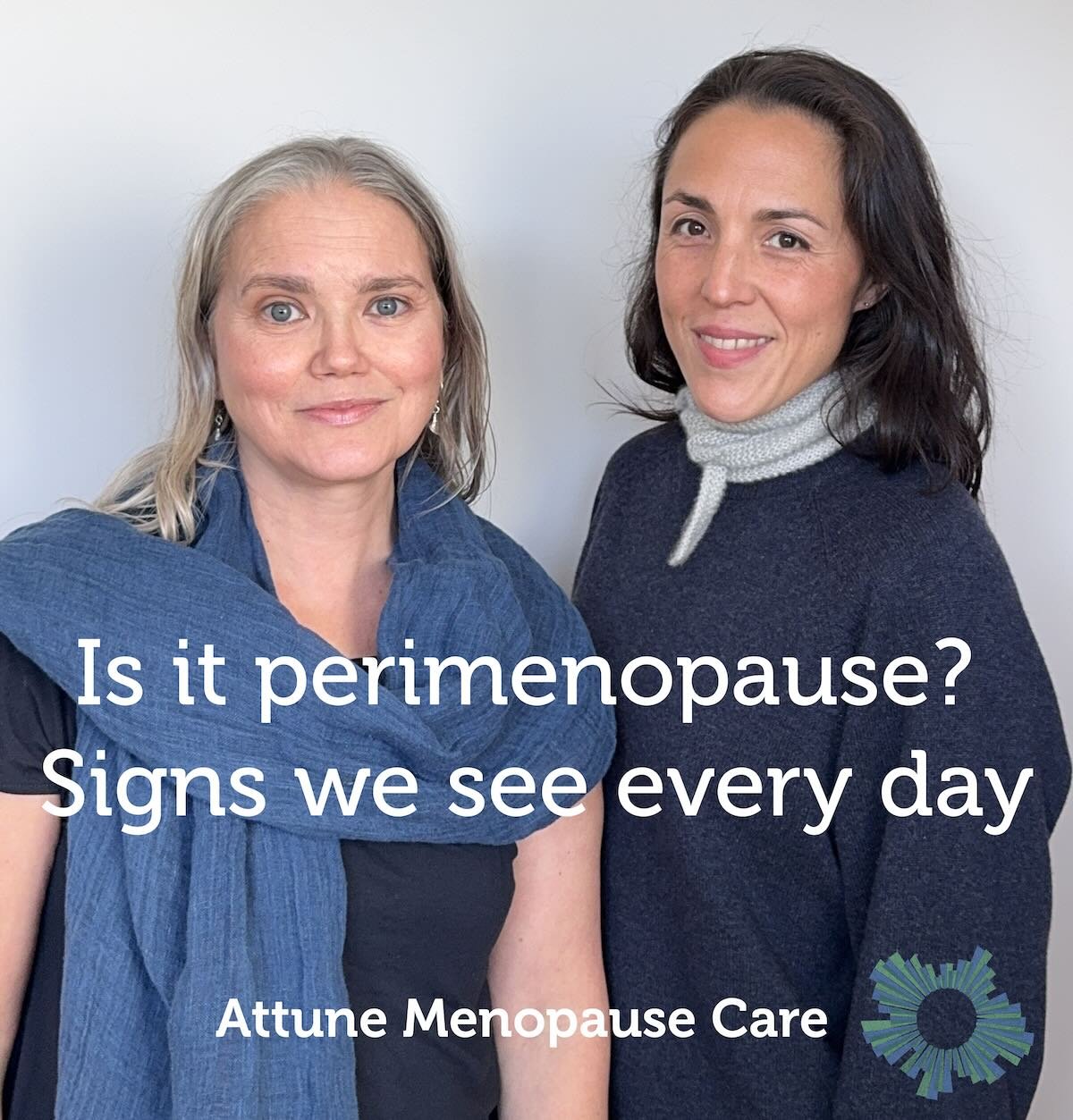
Margaret Ladner and Kiyomi Kimble, Certified Nurse Midwives and Menopause Society Certified Practitioners at Attune Menopause Care, provide unhurried care to clients with perimenopause symptoms—read on to see if what you're experiencing may be perimenopause.
If you've been feeling "off" lately—maybe your periods have changed, you're waking up at 3 AM for no reason, or you're suddenly anxious in a way you've never experienced before—you might be wondering if something is seriously wrong. The answer might surprise you: you could be entering perimenopause.
Most of our clients at Attune Menopause Care are navigating perimenopause, and we've noticed something important: many people aren’t sure they're in this transition until we talk through their symptoms together. If you're in your late 30s or 40s and experiencing changes that don't quite add up, this post is for you.
What Exactly Is Perimenopause?
Perimenopause is the transition phase before menopause—the time when your body is shifting from the reproductive stage to the post-reproductive stage. You're officially in menopause when you've gone 12 full months without a menstrual period. The average age of menopause is 51, though it's completely normal to reach menopause anywhere between 45 and 56 years old.
Here's what catches many people off guard: perimenopause symptoms can start up to 10 years before your final period.
Do the math with us: If menopause happens around age 51 (and as early as at 45), symptoms can begin as early as your late 30s or early 40s—long before most people expect it. This is why we often see clients in their late 30s or early 40s who are confused about what's happening to their bodies.
Even worse, many have sought care from other providers and been told that they “are too young” or that because they don’t have hot flashes it isn’t due to perimenopause.
The First Sign: Your Period Changes
One of the earliest and most reliable indicators that you're entering perimenopause is a change in your bleeding patterns. These changes happen because your hormone levels—particularly estrogen and progesterone—are starting to fluctuate.
Cycles Get Shorter First
If you've had regular 28-day cycles (measured from the first day of bleeding to the next first day of bleeding) for years, you might notice your cycles shortening to 24 or 25 days, or even 21 days. This is often one of the first signs of perimenopause.
Important note: If your cycles become shorter than 21 days, please see a healthcare provider for evaluation. While this can be a normal part of perimenopause, cycles that are very short or very heavy can also be a sign of something more serious, like endometrial cancer or other conditions. It's always better to get checked out.
Then Cycles Start Spacing Out
As perimenopause progresses, the opposite happens—your periods start spacing out. You might skip a month here and there. What used to be a reliable monthly cycle becomes unpredictable. You might go two months without a period, then have one, then skip three months.
This irregularity is completely normal during perimenopause, but it can be unsettling if you're not expecting it.
Hot Flashes: The "Hallmark" Symptom (That's Not Always Obvious)
Hot flashes are considered the hallmark symptom of perimenopause and menopause, but here's something that surprises us: many of our clients are experiencing hot flashes without realizing that's what they are. While some people wake up drenched in sweat, others don’t — but that doesn’t mean that the sudden feeling of heat isn’t a hot flash.
What Does a Hot Flash Actually Feel Like?
A hot flash typically involves:
Suddenly feeling intensely hot in your face, chest, and neck
The sensation lasting anywhere from 1 to 5 minutes
Feeling normal—or even cold—shortly after
The nighttime clue: Hot flashes happen more frequently at night than during the day. If you find yourself waking up needing to throw the covers off because you're too hot, and then pulling them back on just minutes later because you're cold, that's likely a hot flash (often called a "night sweat").
Many people dismiss this as their bedroom being too warm or their partner turning up the heat, but if it's happening regularly and involves this cycle of hot-then-cold, perimenopause is the likely culprit.
The Symptoms That Bring Most People to Our Practice
While hot flashes get all the attention, other symptoms often drive people to seek help—sometimes even before hot flashes appear.
Mood Changes: Anxiety and Depression
New-onset or returning anxiety and depression—especially anxiety—is one of the most significant and distressing symptoms we see in midlife women. Many of our clients come to us primarily because of mood changes, not hot flashes.
Here's what we hear constantly: "I've never had anxiety like this before" or "My depression came back even though I've been stable for years."
We know that midlife women carry enormous loads—managing careers, teams at work, children, aging parents, partners, volunteer commitments, household responsibilities. It would be easy to blame anxiety on these external pressures alone. But what we see in practice suggests that something else is at play: hormonal changes during perimenopause appear to be a major contributor to mood symptoms.
For many people, mood changes are actually the first sign they're in perimenopause—appearing even before period changes or hot flashes.
Sleep Disruption
This is one of the most bothersome symptoms we treat. The pattern usually looks like this:
You fall asleep fine initially
You wake up multiple times during the night
When you wake up, anxiety kicks in or your brain starts churning
You have a hard time getting back to sleep
Sometimes these nighttime wake-ups are caused by hot flashes (you wake up sweating or overheating). But just as often, the sleep disruption happens independently of hot flashes—it's its own symptom.
Why this matters so much: Night after night of disrupted sleep has profound effects on your mood, cognition, and overall health. It makes you irritable. It contributes to brain fog. It affects your ability to function at work and at home. It increases your risks of chronic disease. Sleep disruption is not something to dismiss as "just part of getting older."
Brain Fog
"Am I getting early dementia?" This is a question we hear regularly from intelligent, accomplished, high-functioning women who are suddenly:
Forgetting words mid-sentence
Walking into rooms and forgetting why
Struggling to concentrate in meetings
Feeling less sharp than they used to be
Brain fog causes real distress. Many of our clients worry they're losing their edge at work or that something is seriously wrong with their brain.
Here's the fascinating part: Researchers like Dr. Lisa Mosconi (author of The Menopause Brain) have shown us that the brain is actually undergoing significant changes during perimenopause—a kind of "gut rehab" or reconfiguration. This isn't damage; it's transformation.
The brain is adapting for a new phase of life, and during this transition period, many women experience cognitive changes. The good news: For most women, brain fog lifts after a few years once the brain has completed its transformation. It's temporary, not permanent.
But while some of the brain fog during perimenopause is due to this normal and natural restructuring process, hormonal shifts and sleep disruption of perimenopause can worsen it significantly.
Other Common Symptoms
While bleeding changes, hot flashes, mood changes, sleep disruption, and brain fog are what drive most of our clients to seek care, perimenopause can bring many other symptoms, including:
Vaginal dryness
Painful intercourse
Low libido
Weight changes (especially around the midsection)
Joint aches and pains
Hair changes (thinning or texture changes)
Skin changes (dryness, changes in elasticity)
Heart palpitations
In this "menopause moment" we're living in, many symptoms are being attributed to perimenopause—some quite surprising (itchy ears, burning mouth). If you have a constellation of symptoms that you suspect might be part of perimenopause, we are happy to work with you to try to figure it out.
The Good News: We Have Effective Treatments
If you're reading this and recognizing yourself in these symptoms, please know: you don't have to just "tough it out."We have effective, evidence-based treatments for:
Hot flashes and night sweats
Mood changes (anxiety and depression)
Sleep disruption
Vaginal dryness and painful intercourse
Irregular or heavy bleeding
And more
Treatment options include hormone therapy, non-hormonal medications, lifestyle modifications, and targeted approaches for specific symptoms. The key is finding what works best for your body, your symptoms, and your health history.
When Should You Seek Care?
Consider seeing a menopause care provider if:
Your bleeding patterns have changed significantly
You have cycles shorter than 21 days or bleeding that seems unusually heavy
Hot flashes or night sweats are disrupting your sleep or daily life
You're experiencing new or worsening anxiety or depression
Sleep disruption is affecting your functioning
Brain fog is causing distress or affecting your work
Any symptoms are impacting your quality of life
You don't need to wait until symptoms become unbearable. Early intervention can make a significant difference in how you experience this transition.
You're Not Alone
If you're in your late 30s or 40s and feeling like something is "off," trust yourself. Your body is giving you information. Changes in your menstrual cycle, sleep, mood, or cognition aren't something you need to push through alone.
At Attune Menopause Care, most of our clients are navigating perimenopause, and we've built our practice specifically to support you through this transition. We take the time to listen, understand your unique symptoms and concerns, and partner with you to find solutions that work for your life.
Perimenopause is a normal life transition, but that doesn't mean you have to accept feeling terrible. Help is available, and you deserve to feel like yourself again.
Ready to talk about what you're experiencing? We offer one-hour new patient visits where we take the time to really hear you and develop a personalized plan. Schedule your visit or call us at (872) 253-4891.
Have questions? Contact us at office@attunemenopausecare.com
Attune Menopause Care provides specialized menopause and perimenopause treatment in Chicago's Wicker Park neighborhood and via telehealth throughout Illinois. Led by Margaret Ladner and Kiyomi Kimble, both Certified Nurse Midwives and Menopause Society Certified Practitioners, we offer expert, personalized care during this important life transition.
